

You’ve been thinking about it for a while, about how to start an online business. Maybe you want to earn extra income on the side. Maybe you want to stop relying on a single paycheck. Or maybe you just want to build something that’s yours.
The problem isn’t motivation – you have plenty of that. The problem is that every time you search for advice on how to start an online business, you get hit with ten different opinions, fifty tool recommendations, and zero clarity on where to actually begin.

This guide is different. It’s written specifically for beginners who want a clear, honest, step-by-step path – without the hype, without the unnecessary complexity, and without being sold a dream that doesn’t reflect reality.
By the end of this guide, you’ll know exactly how to start an online business in 2026 – which model fits your situation, what tools you actually need, how to build your first website, and how to start getting traffic without years of experience.
What you will learn in this guide: Step-by-step process
- How to choose the right business model for your goals.
- The 7 steps to go from zero to a live online business.
- Which tools are worth your money and which ones to skip.
- The most common beginner mistakes and how to avoid them.
- A realistic timeline for when to expect results.
Why 2026 Is Still a Good Time to Start an Online Business

One of the most common things beginners worry about is whether it’s too late. The market feels crowded, competition seems intense, and it’s easy to assume all the good niches are taken.
Here’s the truth: the internet is still growing. More people come online every year, more businesses are moving digital, and more consumers are comfortable buying products and services they find through search and social media. That means demand is still increasing – not shrinking.
What has changed is the noise level. There’s more average content, more generic advice, and more cookie-cutter websites than ever. But that’s actually an opportunity, not a barrier. When you build something genuinely useful – a site with real recommendations, honest reviews, and clear guidance – you stand out easily against the sea of low-effort content.
The tools available in 2026 also make starting faster and cheaper than it has ever been. You can build a professional website without writing code, find hosting for under $5 a month, and use AI tools to speed up your content research and writing process. The technical barriers that used to stop beginners simply don’t exist the way they once did.
The real opportunity in 2026: Key insight
The market isn’t too crowded – it’s too full of unhelpful content. A focused, genuinely useful site in any niche still has real room to grow.
Step 1: Choose the Right Online Business Model
Before you build a website or buy a domain, you need to decide what kind of online business you are actually building. This is the decision most beginners skip – and it’s the main reason they end up confused three months in.
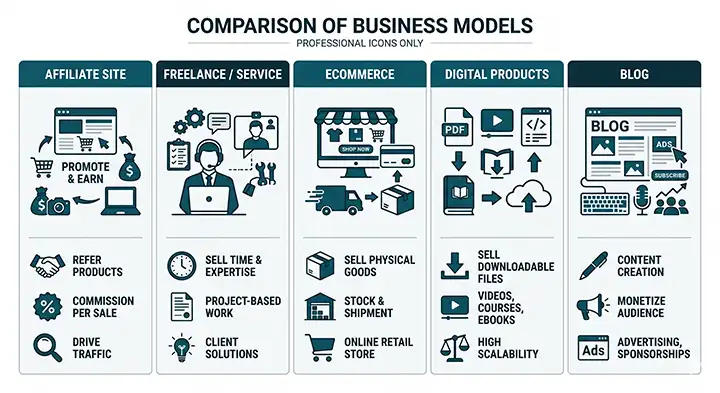
There are five beginner-friendly business models worth considering in 2026. Each one works differently and suits different skills, budgets, and goals.
Affiliate content site
You create a website, write helpful articles and reviews, and earn a commission when readers click your links and purchase the tools or products you recommend. This is the model RexoHub is built on. It requires consistent content but has low startup costs and scales well over time.
Best for: People who enjoy writing, researching tools, and helping others make decisions.
Freelance or service business
You offer a skill – design, writing, development, marketing, consulting – to clients who pay you for your time or project output. You can start with zero audience and earn income relatively quickly. The ceiling is your available hours unless you build a team.
Best for: People who already have a marketable skill and want to monetize it online.
eCommerce store
You sell physical or digital products through an online store. Platforms like Shopify make it straightforward to set up a store, accept payments, and manage inventory. It requires more upfront investment than a content site but can scale significantly with the right product.
Best for: People with a product idea, a supplier relationship, or an interest in retail.
Digital products
You create something once – a template, a course, an ebook, a Notion dashboard – and sell it repeatedly. High profit margins, no inventory, and completely scalable. The challenge is building an audience to sell to.
Best for: People with specific expertise or skills they can package into a product.
Blog or niche authority site
Similar to an affiliate site but broader. You build an audience around a topic, grow traffic through SEO and social media, and monetize through advertising, affiliate links, sponsorships, or your own products. Takes longer to monetize but builds strong long-term value.
Best for: People with a genuine interest in a topic and the patience to build consistently over time.
Which model is best for complete beginners? Our recommendation –
If you’re starting from scratch with no existing audience or product, an affiliate content site is the most practical choice. Low startup cost, no customer service, no inventory – just content and recommendations. It’s exactly how RexoHub is built.
Step 2: Pick a Focused Niche
Once you’ve chosen a business model, you need to decide what topic or market your business will focus on. This is your niche.
The biggest mistake beginners make here is going too broad. ‘Technology’ is not a niche. ‘Online business’ is not a niche. ‘Best project management tools for freelance designers’ is a niche.
A good niche has three qualities: there are people actively searching for information about it, those people have a problem your content or product can solve, and there’s a realistic way to make money from it – whether through affiliate commissions, product sales, or services.
How to find a niche that works for you
- Write down three topics you know well or genuinely enjoy learning about
- For each topic, ask: would people pay for products or services in this space?
- Search Google for questions in your topic – if people are asking, there’s demand
- Check if affiliate programmes exist for tools or products in this space
- Look at existing sites in the niche – if some are doing well, the niche has proven demand
You don’t need to find a niche no one has ever covered. You need to find a niche where you can do better than the existing content – more specific, more helpful, more honest, more beginner-friendly.
Step 3: Choose Your Platform and Build Your Website
Your website is the foundation of your online business. Everything else – your content, your affiliate links, your product pages – lives on it. So choosing the right platform matters.
The good news is you don’t need to overthink this. For most beginners, there are two clear paths:
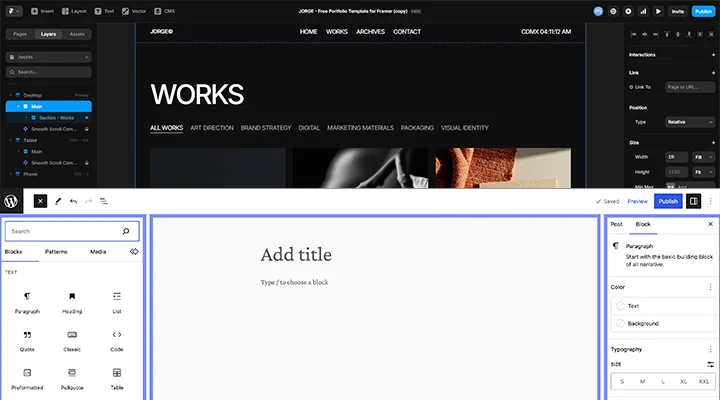
Option A: Use a website builder (Framer, Webflow, Wix)
Website builders let you create a professional-looking site visually, without touching any code. Framer is our top recommendation for beginners who want a modern, fast-loading site with minimal friction. It has a free plan, excellent templates, and an editor that most beginners can pick up in an afternoon.
Webflow is a stronger choice if you want more design control and are willing to spend a few days learning the tool. Wix is the most flexible all-in-one option if you want the most built-in features from day one.
Option B: Use WordPress with hosting
WordPress powers over 40% of all websites and is the most flexible content management system available. It’s the better long-term choice for content-heavy affiliate sites and blogs because of its superior SEO capabilities, plugin ecosystem, and full ownership of your site.
The trade-off is that you’ll need to set up hosting separately, install WordPress, and choose a theme. It’s more setup work than a website builder – but it’s not difficult, and there are beginner guides that walk you through every step.
Helpful resource: Related guide
Read the full comparison of the best website builders for beginners to see a detailed breakdown of every major platform with pricing and use-case recommendations for beginners.
Step 4: Get a Domain Name and Hosting
Your domain name is your website’s address on the internet – for example, rexohub.com. Your hosting is the server that stores your website files and keeps it accessible online.
If you’re using a website builder like Framer or Wix, hosting is included in your plan – you don’t need to set it up separately. If you’re using WordPress, you’ll need to purchase hosting from a provider and connect your domain.
Choosing your domain name
- Keep it short – 2 or 3 words maximum
- Make it easy to spell and say out loud
- Use .com if available – it’s still the most trusted extension globally
- Avoid hyphens and numbers – they make a domain harder to remember
- Don’t spend weeks on this – a decent name chosen quickly beats a perfect name chosen never
What to look for in beginner hosting
- Simple, guided setup – you shouldn’t need technical knowledge to get started
- Reliable uptime – your site needs to be accessible at all times
- Affordable entry-level pricing – you don’t need enterprise features on day one
- Good customer support – live chat or email support you can actually reach
- Free SSL certificate included – non-negotiable for a secure, credible site
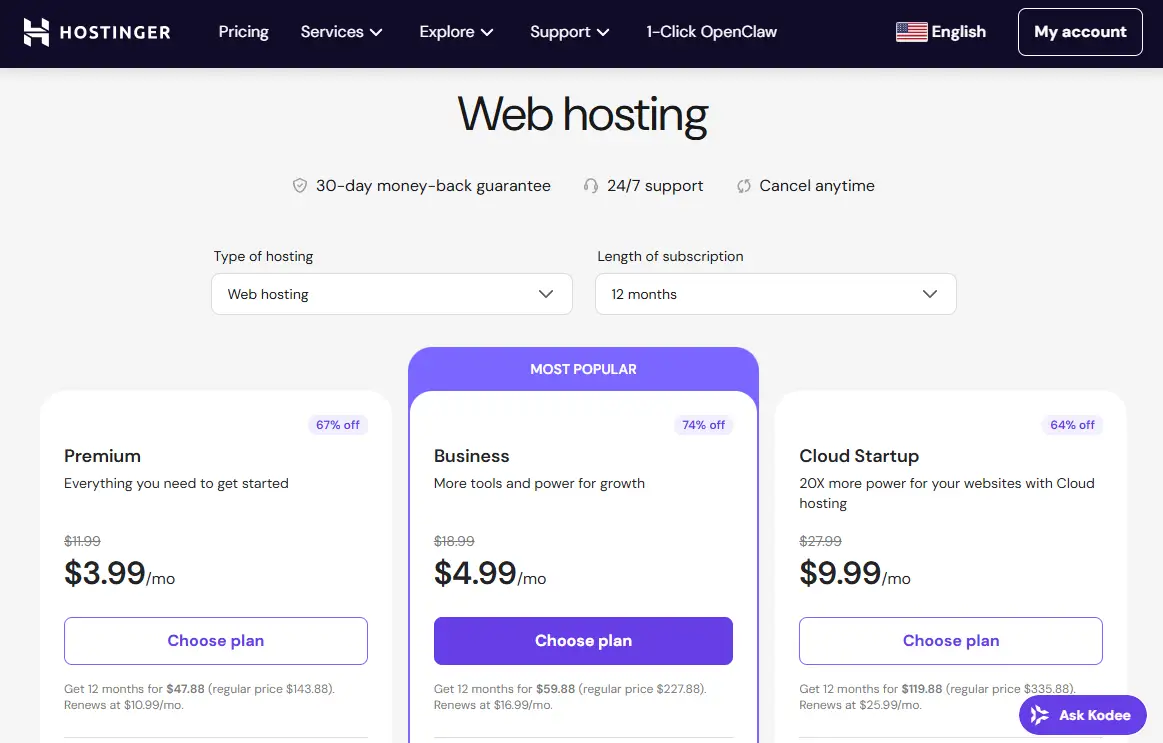
For beginners, Hostinger is the hosting provider we recommend most often. It starts at under $3 per month, includes a free domain with most plans, has a straightforward setup process, and offers responsive support. It’s what RexoHub runs on.
Best Value Hosting Hostinger
Affordable, beginner-friendly hosting with fast performance, free SSL, and simple setup. Starts at under $3/month with a free domain included.
Get started -> hostinger.com
Step 5: Set Up the Right Tools (Keep It Simple)
One of the fastest ways to slow yourself down when starting an online business is buying too many tools before you need them. Most beginners accumulate a collection of subscriptions in the first month and end up overwhelmed and underfocused.
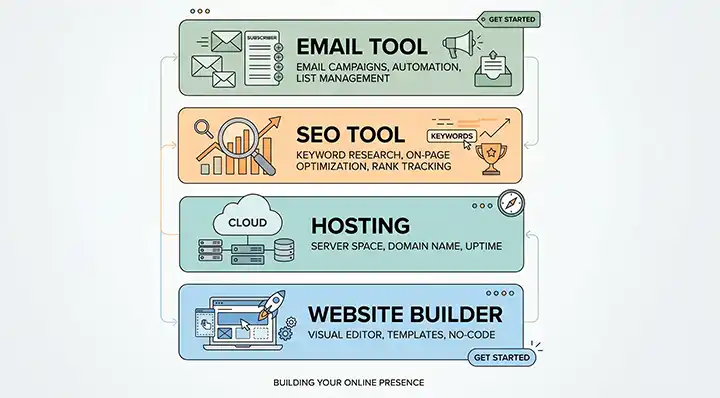
Start with the minimum. Here’s the exact tool stack you need in your first 90 days – and nothing more:
Website Builder Framer
Build a modern, professional website without code. Free plan available – upgrade when you’re ready for a custom domain.
Try free -> framer.com
Best Value Hosting Hostinger
Reliable, affordable hosting for beginners. Includes free domain, SSL, and easy WordPress installation.
Get started -> hostinger.com
SEO & Keyword Research Semrush
All-in-one SEO toolkit for finding keywords, tracking rankings, and planning content. Free trial available
Try Semrush -> semrush.com
Email Marketing MailerLite
Simple, beginner-friendly email tool to start building your audience from day one. Free up to 1,000 subscribers.
Try free -> mailerlite.com
That’s it. Four tools. One for building, one for hosting, one for visibility, one for audience. Don’t add anything else until you’ve outgrown what you have.
Pro tip on tools: Save money with AppSumo
AppSumo (appsumo.com) offers lifetime deals on software tools – meaning you pay once instead of monthly. Check it for SEO, email, and content tools before buying a standard subscription. It can save you hundreds of dollars per year.
Step 6: Create Content That Actually Helps People
Your content is what brings people to your site and builds trust with them over time. Whether you’re writing affiliate reviews, service pages, or product descriptions, the goal is the same: help the reader make a better decision or solve a real problem.
For most beginners building an affiliate or content site, this means writing articles. And the most important thing to understand about writing for SEO is this: write for people first and search engines second. Google has become extremely good at identifying content that genuinely helps readers – and rewarding it with rankings.
What content to start with
Don’t start by writing whatever you feel like. Start with purpose. For an affiliate site, you want a mix of three content types:
- Informational guides: Answer a question your audience is asking. Example: ‘What is web hosting?’ These build topical authority and trust.
- Comparison articles: Help readers choose between two options. Example: ‘Framer vs Webflow for beginners.’ These have high commercial intent – readers are close to making a decision.
- Review articles: Give an honest, detailed assessment of a specific tool. Example: ‘Hostinger Review: Is It Worth It for Beginners?’ These are your money pages – they drive affiliate clicks directly.
How to structure every article for SEO
- Use a clear H1 title that includes your target keyword
- Write a strong intro that addresses the reader’s problem in the first two sentences
- Break content into H2 and H3 sections – no wall of text
- Include a comparison table or summary box for listicles
- Add a FAQ section at the end – these often appear in Google’s People Also Ask results
- End with a clear, natural CTA – tell the reader what to do next
Step 7: Start Getting Traffic to Your Site

Publishing your website and writing your first articles is a huge step. But without traffic, no one will see your work. Here’s how to start building an audience as a beginner, without needing a big budget or an existing following.
SEO – your most valuable long-term channel
Search engine optimisation (SEO) is the process of making your content show up when people search for related terms on Google. It’s the most sustainable traffic source for a content-based online business because it compounds over time – each article you rank for brings consistent traffic without ongoing effort.
SEO takes time. Most new sites don’t see meaningful organic traffic for the first 3 to 6 months. But if you build your content structure correctly from the start – with proper keywords, clear headings, internal links, and helpful content – that investment pays off for years.
Social media – for early momentum
While your SEO is building, social media gives you a way to get eyes on your content immediately. You don’t need to be everywhere. Pick one platform where your target audience spends time and share your content there consistently.
Reddit is particularly useful for new sites. Sharing genuinely helpful articles in relevant subreddits (r/entrepreneur, r/webdev, r/juststart) can drive early traffic and create backlinks that help your SEO.
Manual outreach – the underrated shortcut
Reach out to other content creators, bloggers, or tool communities in your niche. Comment helpfully on relevant posts. Contribute to forums. Mention your content where it’s genuinely relevant. This takes time but builds real relationships and early credibility that no algorithm can replicate.
Common Mistakes to Avoid When Starting an Online Business
Most beginners struggle not because they lack drive or intelligence – but because they fall into the same predictable traps. Here are the four most common ones and how to avoid each of them.
1. Switching niches or tools before giving them a real chance
It’s tempting to pivot when things feel slow. But the first 3 months of any online business are always slow – that’s just how it works. Constant switching wastes the time you’ve already invested and resets your progress. Commit to a niche and a platform for at least 6 months before deciding it’s not working.
2. Picking a niche that’s too broad
‘Technology’ is not a niche. ‘Best project management tools for remote freelancers’ is a niche. The broader your topic, the harder it is to rank for anything, the harder it is to build a recognisable brand, and the harder it is to create content that genuinely helps a specific person. Go narrow first – you can always expand later.
3. Obsessing over website design before publishing anything
A clean, simple, live website beats a beautiful website that’s still being perfected six months from now. Your first 10 articles matter far more than your homepage design. Launch with something good enough and improve it as you go.
4. Ignoring SEO from the start
SEO isn’t something you bolt on later. If you write 20 articles without keyword research, proper headings, or internal linking, you’re building on a weak foundation. Learn the basics before you publish your first piece and apply them consistently from day one.
How Long Does It Actually Take to Make Money?
This is the question everyone wants answered, and the honest answer is: it depends on your model, your consistency, and how useful your content actually is.
For a content-based affiliate site, here’s a realistic timeline based on consistent effort:
- Months 1-2: Set up your site, publish your first 10-15 articles, submit to Google Search Console. No meaningful traffic yet – this is completely normal.
- Months 3-4: Google starts crawling and indexing your content. You may see your first few hundred monthly visitors. Keep publishing.
- Months 5-6: If your content quality is solid and your SEO basics are in place, organic traffic starts to grow more noticeably. First affiliate clicks begin appearing.
- Months 6-12: With 40-60 published articles and a clean site structure, traffic compounds. First consistent affiliate income becomes realistic.
- Year 2+: Authority builds, rankings improve, and income grows with the site. This is when the compounding effect kicks in fully.
These timelines are realistic for someone publishing 3-5 quality articles per week with proper SEO. If you publish less frequently or with lower quality, it takes longer.
The right mindset for year one: Set realistic expectations
Your first goal is not income. Your first goal is a well-structured site with useful content that Google can trust. Income follows trust – and trust takes time to build. Focus on the foundation.
Frequently Asked Questions
Do I need money to start an online business?
You can start with very little. A domain name costs around $10-15 per year. Basic hosting starts at under $3 per month. A website builder like Framer has a free plan. If you’re starting a content or affiliate site, you can realistically launch for under $50 total. The main investment in the early stages is your time, not your money.
Do I need technical skills or coding knowledge?
No. The tools available in 2026 are specifically designed for non-technical beginners. Website builders like Framer and Wix let you build a professional site by clicking and dragging – no code required. You do not need to know how to code to run a successful online business.
What is the easiest online business to start for a complete beginner?
An affiliate content site is the most beginner-friendly business model to start. You don’t need a product, you don’t handle customer service or shipping, and you can start with a very small budget. You write helpful content, recommend tools and products you’ve researched, and earn a commission when readers buy through your links.
How do I choose the right niche?
Look for the overlap between three things: a topic you can write about consistently without losing interest, an audience with real problems that need solving, and products or services you can recommend as an affiliate or sell directly. You don’t need to be the world’s leading expert – you just need to know more than a complete beginner and be willing to research and share honestly.
Can I start an online business while working a full-time job?
Absolutely – and most people do. The early stages of building an online business can be done in the evenings and on weekends. You don’t need to quit your job to start. In fact, having a steady income while you build means you can make decisions based on what’s right for your business rather than what pays the bills fastest.
Ready to Start an Online Business? Here’s Your Next Step
You now have a complete picture of what it takes to start an online business in 2026 – the right model, the right tools, the right content approach, and realistic expectations for what to expect in your first year.
The hardest part isn’t knowing what to do. It’s starting. And the best way to start is to make one decision and act on it today – not next week, not after more research.
If you’re not sure which platform to build on, read our guide to the best website builders for beginners. If you need hosting, Hostinger is where we’d send a friend starting out today. And if you want a full step-by-step path through every decision a beginner needs to make, our Beginner Roadmap covers it from start to finish.
